BIOLOGYMitochondria to determine species: an insight into DNA bar codes
What most of you (the non-biologists) might not know is that mitochondria and chloroplasts contain their own DNA, different from the genomic DNA. There’s an interesting story of how eukaryotes incorporated these small organelles into themselves. Mitochondria and chloroplasts are believed to have prokaryotic origins; what that means is that they descended from free-living bacteria and somehow started living inside eukaryotic cells (a symbiotic relationship) and over time became part of the eukaryotic organism. But what even many of us (the biologists) don’t know is how mighty important the mitochondria really are.
Yes, sure they make ATP which is the energy currency of living organisms without which all of the metabolic reactions in our body will be unable to proceed leading to our death. They have an even more inherent significance due to the DNA they contain. Mitochondria have a rather modest DNA collection – a mere 37 genes compared with more than the 20,000 in the nucleus (for vertebrates). Now comes the interesting twist, even within this little genome, researchers have found a 648-nucleotide sequence which is the ultimate identifier of species. Because it can distinguish between closely related species and even classify new species from identical-looking ones, it is called the DNA bar code. By definition, the DNA bar code is a unique identifier. Between any two humans, it varies at no more than two positions. By comparison, humans differ from chimpanzees at approximately 60 sites, and from gorillas at about 70. How brilliant is that? Anyone who knows the long tedious processes required to distinguish or identify species would realize what a gift this is to taxonomists and geneticists. To simply have a nucleotide sequence stamped on you that distinguishes you from every other species on the planet is rather convenient. Researchers believe that this particular sequence becomes unique after two species split from their common ancestor. However, researchers will be researchers. Molecular biologist Dan Mishmar and his colleagues at the Ben-Gurion University of the Negev in Beer-Sheva, Israel, put forward this new hypothesis; that the bar codes do not become unique just ‘because’ the two species split but they might even be important ‘drivers’ of the process of speciation. What they propose is that this particular stretch of mitochondrial DNA might be responsible for undermining the reproductive compatibility within a species when it conflicts with the sequences in the nucleus. This is how they work out the incompatibility. Like, I’ve already mentioned, mitochondria are important for respiration. For respiration to take place, large protein complexes are required that can be made up of as many as 43 subunits. These subunits need to work very intimately with each other or the complex would be disrupted and respiration won’t work. Now, suppose there is an enzyme required for respiration which is made up of 13 subunits, 3 of these subunits are coded by the mitochondrial genes (including the bar code gene) while 10 are coded by the nuclear genes. So, if the mitochondrial DNA has changed, and the subunits don’t work together properly then the enzyme fails to perform its function. What makes this intricate mechanism even more fragile is that these two genomes evolve in different ways. Nuclear genes are mixed by sexual reproduction and in each generation new alleles are introduced while the mitochondrial DNA divides in an asexual fashion. Every individual receives the mitochondrial DNA from only their mother. What’s more is that the mutation rates for the two genomes are different from each other; mitochondrial genes change 10-30 times faster. Knowing that the price for failure of compatibility is huge; the two genomes have adapted to work together. For every generation, the mitochondrial genes are tested against the new nuclear genes. If they don’t work together, there can be a developmental failure (leading to death) or a serious reduction in the fitness of offspring, which is called hybrid breakdown. So, selection plays an important role in ensuring that these two genomes work together properly. Here’s the evidence: In 2006, Mishmar while working with Doug Wallace, a geneticist at the University of California, Irvine, found that the nuclear genes which code for the mitochondrial proteins have a similar number of changes as do the mitochondrial genes (thus adapting to the change in the mitochondrial DNA). They also found that these nuclear genes have a much higher mutation rate (ten times faster) than the rest of the genomic DNA (thus adapting to the high mutation rate of the mitochondrial DNA). There have been cases of achieving hybrid breakdown by crossing closely related species of copepods (performed by Ron Burton and his colleagues at the Scripps Institution of Oceanography in La Jolla, California).The offspring of these crosses would have mitochondria from one species matched with the nuclear material of the other. The mismatch suppressed reproduction and cellular respiration of offspring by as much as 40%. So, essentially, these hybrids have low mortality rate and low fertility, what started as a partial reproductive incompatibility could turn into a complete reproductive isolation over time: speciation. However, there are hundreds of different interactions that cause inviability and which one was the original cause is hard to determine. David Rand, a molecular evolutionist at Brown University in Providence, Rhode Island, with Colin Meiklejohn and Kristi Montooth, from Indiana University in Bloomington, has transplanted mitochondrial DNA from different species of fruitfly into the nuclear background of D. melanogaster, and found little evidence of the hybrid breakdown. The deciding factor is the rate of mutation of the mitochondrial DNA. We know that the rates of mutation for different species are ‘very’ different. If the rate of mutation is very slow (as in the case for Drosophila) then the changes in the DNA of different species of Drosophila would be less giving us a negative result. However, when the mutation rate is high (copepods), the degree of hybrid breakdown is higher. But one can ponder, what is the ‘need’ for this high rate of mitochondrial mutation? The answer is ‘adaptation’. The success of a species depends on how well it can reproduce in an environment. Thus adapting to changing environments is necessary for success. This adaptation is brought about by the mutation. This all nice and peachy if you forget that the high rate can also bring about negative mutations which can very probably lead to extinction of a population. But ‘selection’ has a hand in everything. In a case study using mice, it was found that the most detrimental mitochondrial mutations are removed in the germline. Egg cells containing these mutations fail to develop, leaving behind only the healthy egg cells and making a developmental filter. The new idea is, defying the older concepts that mitochondrial DNA is under tight control of selection. If it wasn’t, then mutations would keep building up over time and give a lot of variation. However, we know that in most species the variation in mitochondrial DNA is very restricted. This is explained if this DNA is subject to selection, much of this variation would be eliminated. “Each such ‘selective sweep’ wipes out the common ground between species, and leaves little variation within a species — a nifty trick if you’re looking for a bar code.” So, to summarize: mitochondrial mutations happen relatively quickly because of the heavy selection due to environmental changes. These changes in mitochondrial DNA need compatible changes in the nuclear DNA, which then also changes. If then, nearby populations are mated, hybrid breakdown is observed, the degree of which depends on the rate of mutations. Faster mutations create greater divergence which gives mitochondria a greater role in speciation. Thus, the DNA bar code not only identifies species, it could very well create them. It is as yet too early to claim the bar code being a powerful driver of speciation. Most researchers are careful not to over-claim. However, there is enough evidence to suggest that this area needs more looking into which Mishmar means to do. Nayab Abidi Darwin’s Method: Induction, Deduction, or Synthesis?From Becquerel's uranium rock to Newton's proverbial apple and Fleming's serendipitous observation of penicillin, the way science is done has come to be associated often with a romanticized but highly suspect notion of objectivity. This may very well be the effect on science of inductivism and the bold claim of the proponents of inductivism that science could not possibly lead to any kind of truthful explanation of the world around us without it. The questions any historian of science must then ask are: to what extent does objectivity, as surely as it is the hallmark of science, lead to the best scientific discoveries and further, how do we weight the role of accident, hunch, intuition, experimenters' bias in the role of science especially if they happen to lead us to the right conclusion?
Charles Darwin in his Autobiography stated that he had ‘worked on true Baconian principles…collected facts on a whole-sale scale…and by extensive reading’[1]. Such a canonical biography may be appealing but it is also a dangerous way of approaching history. At some point it must be recognized that evolution by natural selection was not the result of years of observation in which Darwin had no working hypothesis, but instead years of observations geared towards designing proofs for a hypothesis based on little more than a hunch; a frantic search on ‘the species question’ that ensued as little more than a rat race with Alfred Russell Wallace. This is all counter to the inductive procedure. Stephen Jay Gould concurs – in his essay ‘Darwin’s middle road’, Gould argues that Darwin was no inductivist but instead marshaled evidence from many different aspects: The theory of natural selection arose neither as a workmanlike induction from nature’s fact, nor as a mysterious bolt from Darwin’s subconscious, triggered by an accidental reading of Malthus. It emerged instead as the result of a conscious and productive search, proceeding in a ramifying but ordered manner, and utilizing both the facts of natural history and an astonishing broad range of insights from disparate disciplines far from his own.[2] Induction as a scientific method was popularized by the natural philosopher Francis Bacon (1561-1626). Bacon felt that induction should be the only scientific method scientists could conscionably use, for it relies on a truly objective analysis of empirical observations. For Bacon, theories and hypotheses only biased the mind towards one direction and thus were not appropriate for true scientific discovery. Thus, the correct way to do science was to observe the natural world and explain it axiomatically. These axioms, when seen in a holistic manner, should thus be able to best explain natural phenomena. What is then required to follow up from the axioms is procedure of exclusion: in order for an explanation to be generalizable, one has to operate by finding observations that refute that theory in order to arrive at the best one[3]. This of course can be thought of as the process of elimination following the collection of a large set of observations. Induction as a scientific method does not lack critics who find fault with its intrinsic argument, but the idea that induction is the method which should lead to the best science is idealistic, an ideal that can only be reached if one wipes the scientist’s mind clean of all previous experience. To assume that the best scientific discoveries do not arrive through intuition or the desire of the experimenter to observe something particular would be a criminal reading of history. There is little question that Darwin kept in mind the possibility of the mutability of species, especially since evolution was an idea that had already been propounded upon in the form of ‘transmutation’ by Erasmus Darwin, Lamarck as well as Robert Chambers, the anonymous author of Vestiges of the Natural History of Creation, possibly the most recent exposition of evolutionary views available when Darwin was working on his theory. If Darwin did operate by supposition and the proverbial gut feeling, it would fall almost definitively under the category of deductive reasoning. In order to reconcile the two views, it may be argued that Darwin at first practiced wholesale induction which can be corroborated by the curiosity and wonder displayed in his writings about the voyage on the HMS Beagle. Darwin collected large amounts of specimens, all of which he felt he was not qualified enough to categorize, which necessitated the expertise of John Gould, Richard Owen and the like. The collection of this treasure trove of specimens may lead one to falsely believe that Darwin was proceeding inductively by filling in the Baconian ‘tables’. That he then used his gut feeling of Evolution by Natural Selection to explain what he had seen – the gradation in the beaks of the finches, the relation of the Megatherium to the Armadillo, the hermaphrodite barnacles – deductively. John Stuart Mill frames the deductive method in “On the Deductive Method” thus: The mode of investigation which, from the proved inapplicability of direct methods of observation and experiment, remains to us as the main source of the knowledge we possess, or can acquire, respecting the conditions and laws of recurrence of the more complex phenomena, is called, in its most general expression, the deductive method.[4] The central argument logically following from such a framing relies on the fact that the method of induction relies on the collection of vast banks of data; only when the bank is complete can one theorize on observations. What Darwin did was not collect blindly every manner of fact that came his way. Instead, he was exposed to a cultural setting into which evolutionary ideas had already been introduced; therefore he intrinsically viewed every fact that came forth with a mind cognizant of hypothesis even if it wasn’t his own. Hence, induction can never truly be achieved in perfection for scientists do not exist in a sociocultural vacuum; unless of course we view Darwin’s method as selectively inductive i.e. he collected some facts without any prior idea of what those facts might entail. Gould puts forth a critique of inductivism succinctly: Great scientists, the critics [of inductivism] claimed, are distinguished more by their powers of hunch and synthesis, than their skill in experiment or observation.[5] The critics have a point. This essay takes the view that Darwin never worked either purely inductively or deductively. It will demonstrate how Darwin often worked on a hunch, and thus collected his facts not blindly as one might be inclined to believe, but essentially searched for the evidence that could support his hunch of evolution by natural selection. It will further argue that Darwin’s method did not involve mere wide-eyed observation but instead was based on hypotheses that he had already clearly thought about and on analogies from social thought as varied as that of Thomas Malthus and Adam Smith. In order to assess Darwin’s methodology, two levels of analysis will be used. A: Using the Notebooks, Darwin’s recorded thought process will be traced chronologically, marking important occurrences such as his meeting with ornithologist John Gould, and demonstrating through the early effect of Lyell’s geology and Darwin’s unsuccessful hypotheses, that he could not have proceeded inductively. B: Using Darwin’s letters and the Origin, the general themes in Darwin’s collection of evidence to support a work that was two decades or more in preparation will be propounded upon. The themes will thus demonstrate how Darwin selectively chose information to suit his needs especially in the context of Malthusian ideas, and that the best analysis can be made by approaching On the Origin of Species primarily as a work of synthesis and not merely as Darwin’s extrapolation following a great deal of objective observation. When viewing the Origin as a cumulative work, it will also be stressed that Darwin did not simply string together facts from observations in the field of biology, but drew from analogies across disciplines including geology and economics. Darwin’s methodology is widely touted to be inductive due to the voracious intensity of Darwin’s specimen-collecting aboard the HMS Beagle which led to the publication of the 1839 Journal of Researches – the collection of course being an instance of the objectivity with which Darwin viewed his samples. Perhaps it is simply that the voyage is considered often to be the benchmark of Darwin’s inductivism because so little evidence of any transmutationist reflections of Darwin’s recorded before March of 1838 exists. However, post-March 1838, Darwin’s experiences and his subsequent recordings contain three general lines of discussion which he expounded in his notebooks. The first of these lines is Darwin’s anti-Lyellian leanings on the question of the origin of species. One of the primary observations that Darwin made in Journal of Researches was that despite vastly different climates of the mainland of the Americas and the Galapagos islands, often it was to be found that the species of the Galapagos varied more from areas with similar climates than with the mainland. Darwin’s ideas, not logically followed through in the Journal of Researches were put forth as follows: [On the Galapagos Archipelago] Why, on these small points of land, which within a late geological period must have been covered by the ocean, which are formed by basaltic lava, and therefore differ in geological character from the American continent, and which are placed under a peculiar climate – why were their aboriginal inhabitants, associated, I may add, in different proportions both in kind and number from those on the continent, and therefore acting on each other in a different manner – why were they created on American types of organization? It is probable that the islands of the Cape de Verd group resemble, in all their physical conditions, far more closely the Galapagos Islands than these latter physically resemble the coast of America.[6] These ideas of course contrasted with those of Lyell’s whose hypothesis of multiple creation that “each species originated in one place, not many and as a single first pair or lone hermaphrodite…was determined, providentially, by adaptational considerations alone”[7] differed by implicating transmutation. It can be argued that despite Darwin’s close friendship with Charles Lyell, he was influenced more by ideas of transmutationism a la Erasmus Darwin and Lamarck than by Lyell’s – indeed, Darwin’s exposure to notorious transmutationist Robert Grant at Edinburgh did expose him to Zoonomia which Grant was clearly taken in by. Further, in an argument made by Jonathan Hodge[8], Erasmus Darwin “had never been seen by his own family as a skeleton in their closet.” Hodge goes on to say that “for Darwin to be inspired by the family’s precedent in meeting the challenge in the response made to Lamarck by Lyell… was to affirm a concordance between this intellectual life and this economic livelihood.” However, this paper takes the view that the lack of early documentation of Darwin’s ideas on transmutation does not allow this idea to be any more than speculation. Nonetheless, in 1837, Darwin had already opened his Red Notebook which began to deal more definitively – although still more tentatively than his subsequent notebooks – with the idea of transmutation. One important factor in Darwin’s transition brings us to the next line of discussion. March 1837 is often taken to be the benchmark of Darwin’s evolutionist leanings because it was only following his momentous meeting with John Gould that we have any record of his ideas on the transmutation of species. This had to do with Darwin’s observations of the gradations in beak size of his famed Galapagos finches, which as Gould informed him qualified as completely different species. Thus began Darwin’s work on speciation, which he expounded on in the Origin in the form of geographical isolation, island endemism and examples of tortoises. More importantly, however, the next line of discussion can demonstrate not only that Darwin might already have considered the possibility of transmutation, but that even that if he had not, his procedure henceforth hardly qualifies as an inductive approach to science. In reference to the plains of Patagonia, Darwin’s Journal of Researches talks distinctively about his idea of a resemblance of species to extinct forms – he cites examples of the living and fossil Guanoco, the living and extinct Edentata, the similarities between the capybara and the gigantic toxodon, and even the teeth of the rodent and the capybara[9]. All this leads him to hypothesize of the ‘law of succession of types’ which he refers to as the “wonderful relationship in the same continent between the living and the dead.” Often, the observations of the similarities of the living and extinct species are taken to exhibit Darwin’s inductive approach. However, in must be borne in mind, that Darwin’s hypothesis of the law of succession of types, was explained only in the Origin in light of ideas that Darwin had worked out after the publication of the Journal of Researches. How did Darwin explain the origin of species in 1838? Was his evolution by natural selection the first logical account of the extinction of species and the production of new ones? The answer to this lies in the Notebooks in Darwin’s monad theory. This first evolutionary hypothesis of Darwin’s postulated the existence of small living particles that arose from generated from non-living matter in order to explain the ‘evolution of species’ – this hypothesis tried not just to deal with the idea of the extinction of species, but also Darwin’s notion of the number of species being equal and his idea of a species having a life span analogous to that of the monad’s life cycle. Clearly, these ideas in Notebook B refer to just these ideas: If we suppose monad definite existence, as we may suppose is the case. Their creation being dependent on definite laws, then those which have changed most. <<owing to the accident of positions>> must in each state of existence have shortest [23] life. Hence shortness of life of Mammalia.[10] Howard E. Gruber, in his book Darwin on Man, sets out to argue that Darwin by 1838 had already deduced a hypothesis from the observations of previous years – except that his hypothesis was wrong. Thus, Darwin kept following a self-corrective path, tweaking ideas or throwing them out entirely – monad theory, for instance. However, monad theory did convince Darwin of the branching nature of the evolutionary tree, first sketched in Notebook B. Gruber further claims: Darwin has by now encountered one major source of evidence against the principle of monadism. But he cannot discard it directly, for it still provides him with his only mechanism of extinction. He begins to play with the possibility that the factor of environmental change can be used to account for extinction, but this idea does not work very well…especially as he is still thinking in terms of widespread simultaneous extinction[11] This does not sound very much like reasoning that Francis Bacon would approve of for it indicates that Darwin hypothesized - prematurely to be sure for he subsequently found the hypothesis to be an erroneous explanation - and tweaked his hypothesis whenever it conflicted with evidence. Gruber further says: It has been suggested that essentially the whole of Darwin’s mature point of view is reflected in his earliest remarks on evolution, as though his ultimate theory sprang forth at once the moment he turned his thoughts to the matter. Nothing could be further from the truth... Working from his starting point, he had to develop the model of branching evolution first in a formal way, and then to transform it by suffusing it with the idea of struggle and selection. All this cumulatively builds the compelling argument that Darwin could not possibly have proceeded inductively in a Baconian fashion – at every point, even before during Darwin’s voyage at sea, he was aware of evolutionary ideas and their implications, and it is almost certain that he would have looked at evidence through a certain lens, maybe even more than one. Gruber states that “since Darwin had been for so long acquainted with the existence of theories of evolution, since he had been circumnavigating the globe with Lyell’s book, which gives a masterful account of Lamarck’s theory and then criticizes it mercilessly, we must suppose that Darwin thought about evolution from time to time throughout the voyage”[12]. Further, Darwin hardly proceeded through any process of elimination but worked through hypotheses deductively, modifying, keeping some parts and not others, working often on the basis of intuition. Perhaps, it could be said, it was Darwin’s false intuition which led him to ideas of monads and pangenesis that we know today to be tremendously inadequate. Once, of course, Darwin came across Malthus’ work on Population, he found a tenable mechanism by which Evolution could work. This brings us to the second level of analysis. One way to approach the Origin is to view it as a work of synthesis. If we take Darwin’s meeting with Gould as the standard date upon which Darwin became convinced of his theory, what followed was a large period of proof-collection used to support his thesis. He elucidated some of these ideas in 1842 and expanded in an essay in 1844 but the long period between his meeting with Gould and the publishing of the Origin is littered with letters which follow three general themes: the geographical distribution of related species, the number and types of species, and the relationships between species. These letters are distinct from the style in Darwin’s notebooks because of the way in which they marshal evidence. Finally, it will be attempted to place Darwin in a certain context of social thought. Let’s deal with each theme in turn. Darwin’s interest in geographical distribution of ‘types’ is exemplified by his letter to Hooker (Letters 3 Sep 1846 p. 94) where he implores him to point out “whether species of the same genera are found in the intermediate tropical districts…whether in America or elsewhere, whether on high-lands or low-lands” or even his letter to James Smith[13] (Letters 28 Jan 1848, p.102) where he asks about the Geographical Range of Cirripedia. This interest of course follows Darwin’s meeting with Gould and has to do with his belief in geographical isolation as a primary mechanism for natural selection, which, due to Divergence of Character, causes varying adaptations resulting in the formation of new species. For the Origin, this is a formative argument but Darwin takes this even further to talk about the differential ‘severity’, so to speak, of the struggle for existence: “…the struggle will invariably be most severe between the individuals of the same species, for they frequent the same districts, require the same food, and are exposed to the same dangers.” [14] Severity has another role to play, for Darwin also believes that in smaller isolated areas “the race for life will have been less severe.”[15] Clearly, Darwin’s search for facts which could bear on the argument that geographical isolation plays a key role in effecting evolutionary processes would be a deductive approach, for it presupposes the hypotheses of geographical isolation as well as evolution. The argument also ties in with Malthusian ideas of checks as Darwin deals with plants and animals existing in a ‘web of complex relations’: the food web of course being the modern equivalent of such a web. Darwin also expressed interest in the numbers and types of species in order to support an assertion about how abundant groups may have formerly been. This is exemplified by a letter to Hooker: “Would you further oblige me some time by informing me whether in islands like St. Helena, Galapagos, & New Zealand, the number of families and genera are large compared with the number of species”[16]. Darwin’s presupposed ideas of how species can transition into new forms thus constituting altogether different species was connected with Malthusian ideas by the check of extinction. Through Darwin’s famous branching tree diagram, it is clear that number and type is central to the argument, and that he must indeed have been searching for exhaustive proofs. The proofs supported this: through numerous tiny variations which are selected for because they aid survival of the species, new species are formed as species become extinct. Darwin had, by the time of the Origin, hit upon the idea of such counter-balancing and thus his appeal for hard numbers which could show how ‘types’ fluctuated temporally can be seen as a collection of evidence which bear on the issue. Furthermore, Darwin’s letters are constantly indicative of a search for relationships between species which could be concluded from the classification of species. This was a direct consequence of Gould’s revelation that the similar types of finches were separate species, which suggested evolutionary relationships between species and was the cornerstone of his theory. In a letter to British Museum naturalist George Robert Waterhouse, Darwin states: According to my opinion, classification consists in grouping beings according to their actual relationship, i.e. their consanguinity, or descent from common stocks.”[17] Clearly, Darwin was already on the scent in 1843, but even before this Darwin was asking his geologist friend Henry De la Beche, “Have you ever heard of horses of certain colours, having been introduced, whose descendents are now of a different color.”[18] Darwin was obviously looking for evidence of relationships such that evolutionary trees could be constructed – if he could only chart the similarities between ancestors and descendants, he would have obtained a proof of his hypothesis. Darwin’s mechanism of natural selection was clearly drawn from Malthus’ ideas on competition, but his ideas also show interesting parallels with philosophical and economic thought – the philosophical underpinnings of his theory he devoted an entire book to The Descent of Man, and indeed Notebook M prior to the Origin was what he called “full of metaphysics on morals”. Stephen Jay Gould argues that Darwin analogized from sources as far-flung as those of statistician Adolphe Quetelet and even Adam Smith. Consider the implications: In fact, I believe that the theory of natural selection should be viewed as an extended analogy—whether conscious or unconscious on Darwin's part I do not know—to the laissez faire economics of Adam Smith. The essence of Smith's argument is a paradox of sorts: if you want an ordered economy providing maximal benefits to all, then let individuals compete and struggle for their own advantages. The result, after appropriate sorting and elimination of the inefficient, will be a stable and harmonious polity. Apparent order arises naturally from the struggle among individuals, not from predestined principles or higher control.[19] Thus, following on from the intellectual context in which this now places Darwin, one can begin to understand the ways in which he ‘selected for’ evidence for his theory. Given the many motifs in his letters, it is understandable that Darwin was not using the medium simply as a sounding board for his ideas but as ways to beseech for evidence which supported his theory, by 1858 fully framed in light of Malthus’ views. This methodology is infinitely more complex and layered than the simplistic view of science put forth by Bacon and indeed by Darwin in his Autobiography, and doesn’t allow the inductive process to take full credit for a theory as rich and all-encompassing as the theory of Evolution by Natural Selection. The final analysis suggests that to categorize scientific methodology and to chart it out definitively as a process that can only take one specific route and proceed in only one direction is misleading, for much of science is the work not just of synthesis but of recycling, nip-and-tuck processes. This does not in any way imply that the quest for true scientific objectivity is futile, just that it is elusive. Certainly very many of the known scientific truths of today have relied on preconceived notions, serendipitous observations or maybe even the desire of the experimenter to see only his truth emerge out of the laboratory. Objectivity as a principle, thus, may be the hallmark of science, but it is by no means the defining feature of its history. Footnotes: [1]Glick & Kohn On Evolution: Autobiography 1996, p.309-310 [2] Gould, Stephen J. The Panda’s Thumb: More Reflections in Natural History 1992 [3] Stanford Encyclopedia of Philosophy [4] Huxley, Thomas H. Collected Essays: Darwiniana 1860 [5] Gould, Stephen J. The Panda’s Thumb: More Reflections in Natural History 1992 [6]Glick & Kohn On Evolution: Journal of Researches 1996, p.39 [7]Hodge, Jonathan Cambridge Companion to Darwin The Notebook programmes and projects of Darwin’s London years 2nd edition p. 47 [8]Hodge, Jonathan Cambridge Companion to Darwin: The Notebook programmes and projects of Darwin’s London years 2nd Edition [9]Glick & Kohn On Evolution: Journal of Researches 1996, p.17 [10]Glick & Kohn On Evolution: Darwin’s Notebooks 1996, p.54 [11] Gruber, Howard H. Darwin on Man: A Psychological Study of Scientific Creativity p. 146 [12] Gruber, Howard H. Darwin on Man: A Psychological Study of Scientific Creativity p. 134 [13] Burkhardt, Frederick Origins: Selected Letters of Charles Darwin p.102 28 Jan 1848 [14] Glick & Kohn On Evolution: On the Origin of Species 1996 p.173 [15] Glick & Kohn On Evolution: On the Origin of Species 1996 p.192 [16] Burkhardt, Frederick Origins: Selected Letters of Charles Darwin p.84 11 Jan 1844 [17] Burkhardt, Frederick Origins: Selected Letters of Charles Darwin p.80 26 July 1843 [18] Burkhardt, Frederick Origins: Selected Letters of Charles Darwin p.77 7 Feb 1842 [19] Gould, Stephen J. The Panda’s Thumb: More Reflections in Natural History 1992 Kamil Ahsan Note: For a downloadable version of this essay, right click and save the file in the column. The Next Big Thing: Self-assemblies and the Energy crisisTwo weeks ago I had the opportunity of attending one of the many seminars hosted by SSE. The seminar, titled “Next Big Thing” was on self assembling bionanomaterials, Photonics and Biological gold mines and the speaker was Mohammad Safwan Akram, currently a PhD student in Analytical Biotechnology at Cambridge. His research work at Cambridge involved understanding the mechanism by which these particles self-assemble so that they could be manipulated to form specific assemblies that can be used in the field of medicine etc. He also spoke about the idea of harnessing solar energy, for which he was awarded the CambridgeSens Innovative Idea of the Year (read the HEC newsletter entry here, a link provided on the SSE Physics Lab website), and why he wants to come back to Pakistan. This essay attempts to explain Mr. Akram’s ideas of synthetic assemblies and their utility, and the use of biological techniques to solve the energy crisis.
Self-assembling bionanomaterials: Self-assembling bionanomaterials refers to materials that can polymerize to form long chains in a particular arrangement without any external stimulus in a living as well as a non-living environment. Being able to harness these assemblies to form a particular template has many potential functions. In addition, some peptide sequences have a strong affinity to inorganics (including metals such as titanium). Using these sequences and those for self assembling particles we can make fusion constructs of Genetically Engineered Proteins for Inorganics (GEPI’S). Since the protein can identify inorganic components and can self assemble it would act as a linker between the inorganic components while also contributing to the overall structure and function of the assembly. These proteins may have non-specific binding but a buffer could be used to wash certain peptides off, while the one of our choice can remain attached. The inorganic surface to which they adsorb can be well defined such as a crystal or a nanoparticle but even powder could be used. Once an inorganic surface specific protein has been found it could be modified, redesigned and synthesized to form a molecular construct. So for instance, if a person has somehow damaged his/her vertebra, using such a construct (including titanium template) containing sequences with affinity for titanium could be implanted in the patient’s backbone. The proteins would self assemble around the template to form a vertebral implant of great tensile strength. Thus, it has enormous potential for usage in implants. In an article at Physorg.com on Nanoparticle Self-Assembly, Dr. Leroy Cronin, a researcher at Glasgow said: “This discovery could lead the way for the designed assembly of a whole range of precisely-defined nano-particles with applications in electronics, medicine, and catalysis to allow the design of intelligent or smart nano-sensors and nano-functional machines, not to mention the fundamental implications regarding the assembly of complex chemical systems, the most spectacular example of which are living cells.” Innovative idea of the year: The crux of the idea is this: when UV radiation from the sun is absorbed by our skin, pyrimidine monomers (present in our DNA - thus forming the very basis of our genetic material) combine to form a dimer. At the same time, an enzyme in human skin called photolyase splits these dimers into respective monomers by donating electrons as a result of falling UV. Mr. Akram’s idea relied on the assumption that this enzyme can be synthesized in large numbers, and along with an appropriate electrode can be used in solar panels to set up a current to generate electricity. Thus nature is employed to produce power. Solving Pakistan’s energy crisis: In Balochistan, Pakistan has a large but low quality deposit of coal, which is almost of no use but for domestic purposes (Read Mehr’s blog post on coal reserves in the Thar Desert: “Black is the color”). The idea was of setting up a plant in Pakistan, and searching for an appropriate organism that could convert this coal into a much efficient source of fuel such as methane (incidentally, a less environmentally damaging emission than CO2). Although the plan is still in the pipeline, it offers huge possibility of solving Pakistan’s crippling energy crisis. Even though the solar cell may not be 100% effective/efficient, and the idea of harnessing coal energy may not be easy to execute, one can see how we can manipulate bio organisms and biomaterials to solve an abyss of issues concerning our world. Biotechnology may very well be the next big thing for Pakistan. Anum Khan Note: For a downloadable version of this essay, right click and save the file in the column.
|
Links and Pictures for Mitochondria to determine species: An Insight into DNA Bar Codes
Barcode of Life Initiative. Click here. Click here for a Barcode of Life brochure. For a profile of Dan Mishmar, click here. 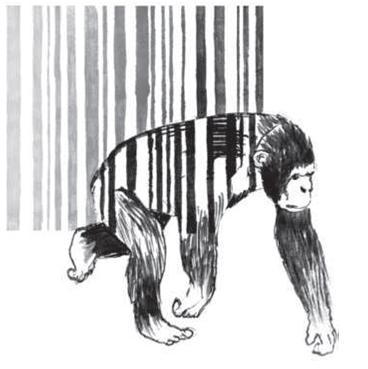 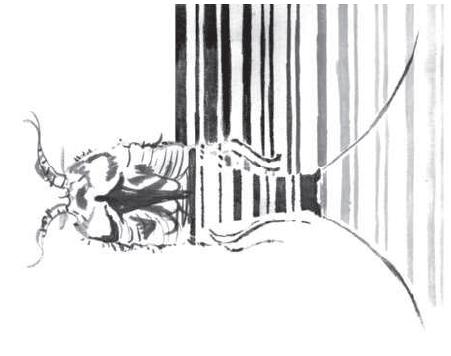  References and Figures for Darwin's Method: Induction, Deduction, or Synthesis? Stephen Jay Gould's essay Darwin's Middle Road. Click here. SJG Archives: Thomas H. Huxley's essay The Origin of Species. Click here. SOURCES: Frederick Burkhardt Origins: Selected Letters of Charles Darwin Thomas F. Glick & Kohn On Evolution Thomas F. Glick What About Darwin? Stephen Jay Gould The Panda's Thumb: More Reflections in Natural History Howard E. Gruber Darwin on Man: A Psychological Study of Scientific Creativity Michael Ruse The Darwinian Paradigm William Paley Natural Theology 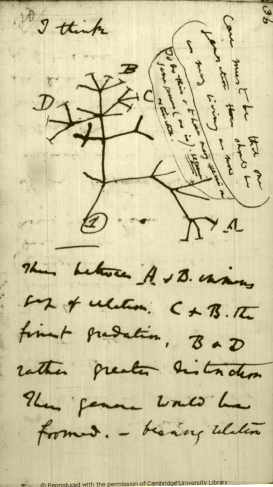 Notebook B sketch 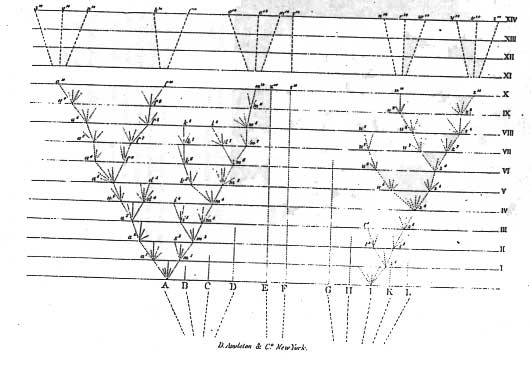 Origin of Species tree 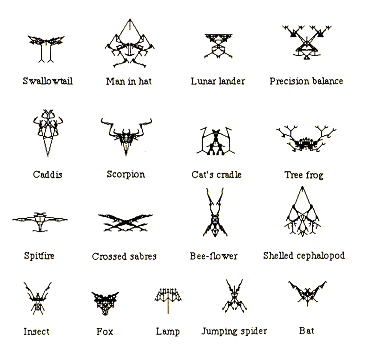 Dawkins' Biomorphs 
References and Figures for The Next Big Thing: Self-assemblies and the Energy crisis Physorg.com: Scientists 'photograph' nano-particle self-assembly - 4 Jan 2010. Click here A paper titled 'Genetically engineered polypeptides for inorganics: A utility in biological materials science and engineering' published by Materials Science and Engineering - April 2007. Click here
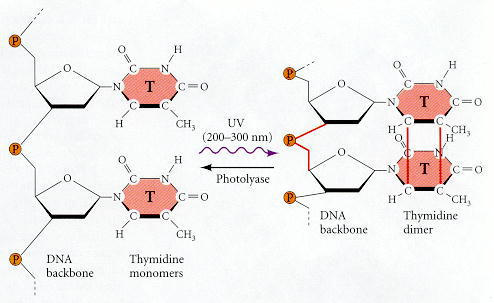 From Developmental Biology 6th Edition - Scott F. Gilbert References and Figures for Common Themes in Doris Lessing and Stephen Jay Gould:
The original paper by Gould and Eldredge Punctuated Equilibrium:
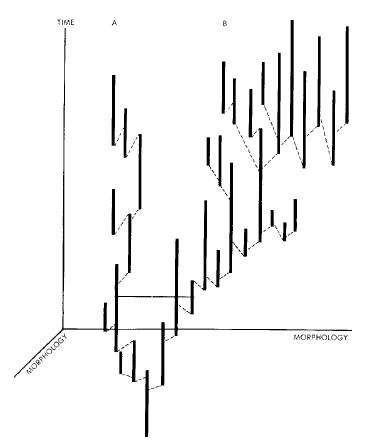 A diagrammatic representation of the ideas of Punctuated Equilibrium, in direct contrast to Phyletic Gradualism which can be imagined as shown below. 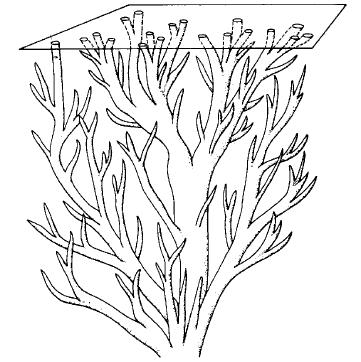 | ||||||||
THE BOX MOVE
